Sustaining Growth Through Fiscal Discipline, Diversification
and Global Leadership
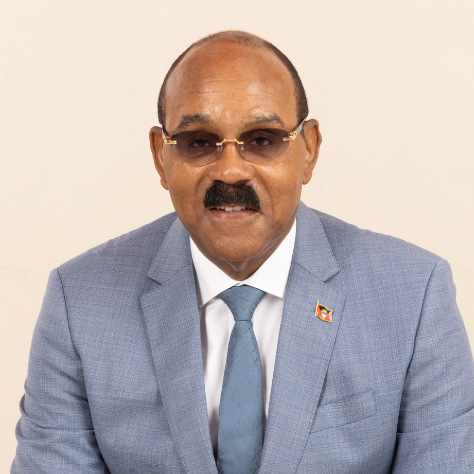
Gaston Browne, Prime Minister
The year 2024 was a landmark year for Antigua and Barbuda’s economic resilience, with growth estimated at over 4% and a notable reduction in public debt. Beyond the resurgence of tourism, what specific fiscal strategies or emerging sectors were the primary drivers of this strong economic performance in 2024, and how do you plan to sustain this momentum into 2026?
We recorded both a significant primary surplus and an overall surplus in 2024, which was historic for a country that had run perennial deficits.
I am pleased to say that 2025 has been even stronger. The primary surplus rose to over a quarter of a billion dollars, the overall surplus exceeded 2024 levels, and public debt declined further to 61.4 per cent, broadly in line with the international benchmark of 60 per cent. This performance is particularly impressive given the vulnerabilities we inherited in 2014, when debt stood at 120 per cent of GDP or more once unbooked liabilities were included. Reducing that burden reflects strong economic growth and fiscal discipline. Looking ahead to 2026, we expect growth of at least 5 per cent, alongside continued primary and overall surpluses to ensure long-term debt sustainability.
Tourism has been a major driver of growth, but it has not been the only one. We have seen record stayover and cruise arrivals, alongside rising investment. The benefits are filtering through the economy. Taxi operators, for example, are earning significantly more, in some cases six-figure incomes, because arrivals have doubled over the past decade without a corresponding increase in operator numbers. Retail and merchandising have also seen gains, and cruise tourism continues to contribute.
At the same time, we are positioning ourselves as a premier overnight tourism destination. In Barbuda, PLH is delivering a multi-billion-dollar luxury development, including a Tom Fazio golf course that will rank among the world’s finest. US-based investors have already committed close to one billion US dollars. Barbuda will remain low-density and exclusive, with no all-inclusive resorts. Each adult Barbudan has been allocated one acre of land to encourage high-quality residential development and preserve lifestyle and community.
Beyond tourism and construction, we are diversifying into education, health and technology. We are expanding medical and tertiary education, including the University of the West Indies Five Islands Campus, which currently has 1,500 students and is expected to grow to 5,000 following a US$200 million expansion. We are also developing a regulated stem-cell and medical wellness industry, alongside fintech, blockchain and stable-coin frameworks. These are areas where we are early movers and where we continue to attract investment.
Your government has taken a global leadership role in climate finance and the Blue Economy, notably hosting the SIDS4 conference in 2024. As you move to make Barbuda the first island in the region powered entirely by renewables, where can private capital play the most effective role in supporting your renewable energy and ocean resource goals?
There are opportunities in ocean wave energy, hydrogen and other emerging technologies. Where we can attract both capital and expertise, we are open to partnerships, including public-private partnerships and power purchase agreements, under which investors can earn reasonable returns over 10 to 15 years while helping to reduce electricity costs for consumers.
These technologies are highly capital intensive and often beyond the reach of the domestic private sector on its own. That is why we encourage foreign investors to partner with local firms, ensuring technology transfer and giving Antiguans an opportunity to share in the profits. Our position is clear: we want our people involved in the commanding heights of the economy wherever possible.
This approach is already being implemented. Antigua Power Company, which is privately owned by Antiguans, is currently partnering with a US firm, EGLE, to supply LNG-generated electricity. That facility will be phased out within the next eight to ten years as we transition to renewables, but the partnership model between foreign capital and local ownership will remain central to our strategy.
The same applies to the blue economy. Antigua and Barbuda is a small state, but a large ocean state, with a vast exclusive economic zone and significant marine assets. While we do not yet know the full scale or commercial viability of those resources, preliminary information suggests the presence of minerals such as lithium. Further exploration will require advanced technology to assess quantities, sustainability and commercial potential.
We also see major opportunities in fisheries. Our economic zone could sustainably support the processing of between 10,000 and 15,000 tonnes of fish and fish products annually, with scope to develop export markets. However, this too requires capital investment and modern technology.
These are largely untapped areas. With the right global partners, we can develop these resources sustainably, generate taxes and royalties for the state, and allow investors to earn fair returns, while ensuring that local participation remains a central pillar of our development model.
Antigua and Barbuda will host the Commonwealth Heads of Government Meeting in 2026, which will place your nation at the centre of the global stage, welcoming leaders from 56 diverse economies. How does your administration intend to leverage this major international summit to drive tangible foreign direct investment, and what specific sectors will you be highlighting to visiting delegates and business leaders?
By hosting the meeting, we will naturally deepen our engagement with global political and business leaders. In addition, there is a dedicated business forum as part of the Commonwealth programme, which will give us direct access to investors across a range of sectors. Our intention is to engage them strategically, identify synergies and convert those opportunities into tangible investments.
Tourism will be a priority. Demand for Antigua and Barbuda remains exceptionally strong, but we simply do not have enough rooms, particularly at the luxury end of the market. Attracting additional high-end properties is central to our strategy of positioning the country as a Caribbean lifestyle destination, and the business forum provides an ideal platform to advance that objective.
Technology investment is equally important. We are expanding an ecosystem that already includes stem-cell therapies, blockchain and stable-coin frameworks, always ensuring that we work with reputable partners. Our aim is to be early movers in areas where we can export digital and technological services. For example, medical technologies such as diagnostic imaging can be provided remotely at a fraction of the cost charged in developed markets, while still offering strong incomes locally. Exporting digital services is therefore a key pillar of our broader digitalisation strategy.
That strategy depends on human capital. We are investing heavily in education to ensure that our people, particularly young people, can compete globally. Our objective is that within the next 10 to 15 years, at least 50 per cent of citizens will hold a first degree or a recognised technical skill. The infrastructure is already in place through the University of the West Indies Five Islands Campus, the Antigua and Barbuda College of Advanced Studies, the Antigua and Barbuda Institute of Continuing Education, and specialist skills centres such as the Harrison Centre.
So I see Antigua emerging firmly as the diplomatic centre of the Caribbean. We are expanding our infrastructure to support that role, including the transformation of an existing facility into a performing arts and conference centre with seating for approximately 950 people. That venue will be completed within the next seven months. Antigua and Barbuda is positioning itself as a leading conference and tourism destination, but more importantly as a hub for regional and international diplomacy.
Since taking office in 2014, your administration has effectively transformed the country into a ‘lifestyle superpower,’ attracting significant FDI into ultra-luxury developments and maintaining the region’s premier yachting calendar. What is your next strategic move to ensure Antigua and Barbuda retains its competitive edge as a key hub for global wealth and luxury tourism?
Human resource development is the cornerstone of our strategy. On a per capita basis, I expect Antigua and Barbuda to become one of the best-qualified countries in the world, measured by the proportion of citizens with degrees or certified skills. We intend to compete on intellect and talent.
Our people have always demonstrated exceptional ability. Sir Vivian Richards, widely regarded as the greatest batsman in cricket history, came from an island of just 100,000 people and dominated a global sport for two decades. That tells you something about the depth of talent we possess. We are now encouraging our citizens to think globally and to monetise their skills across culture, creative industries and sport.
This approach aligns with our broader investment strategy. We are pursuing opportunities in tourism, yachting and marina development, particularly in the mega-yacht segment, where Antigua and Barbuda is exceptionally well suited. We are also focused on climate-related investments in both the green and blue economies, alongside continued expansion of luxury tourism and technology-led sectors.
Ultimately, Antigua and Barbuda will be known for the quality of its people and the skill of its workforce. My Cabinet and I are committed to delivering that transformation. We understand how investors think, how to assess and de-risk projects, and how to create the confidence required for capital to flow. That combination of vision, competence and speed is what is allowing a small state to achieve outsized results.